

Client Type: Residential Victorian House
Location: Hoole, Chester (Conservation Area)
Specialism: Chimney Rebuilds, Reclaimed Brickwork, High-Exposure Lime Mortar
Materials: NHL 3.5 Hydraulic Lime, Reclaimed Cheshire Bricks, Code 4 Lead, Traditional Hair-Reinforced Parge.
Techniques: Hand-Dismantling, Flue Parging, Decorative Corbelled Brickwork.
Hoole is renowned for its stunning Victorian and Edwardian architecture, characterised by ornate brickwork and prominent chimney stacks. These chimneys weren’t just functional flues for coal fires. They were architectural statements.
However, as the highest and most exposed points of a building, they take the brunt of the North West’s weather. Over a century of heat cycles (from the fires below) and freeze-thaw cycles (from the frost above) eventually takes its toll on even the most robust masonry.
We were contacted by a homeowner in the Hoole Conservation Area who had noticed debris falling into their fireplace and visible cracks in the external stack. Upon a drone inspection and subsequent scaffolding, the extent of the damage became clear.
The original lime mortar had almost entirely washed away, a victim of “acid rain” and over 120 years of saturation.
Furthermore, a previous attempt to “cap” the chimney with a heavy cement flaunching had backfired. The rigid cement had cracked, allowing water to seep into the core of the stack. And seeing as the water couldn’t evaporate back out through the cement, it had sat inside the brickwork. This froze and expanded during the winter, which had “jacked” the top courses of brick loose.
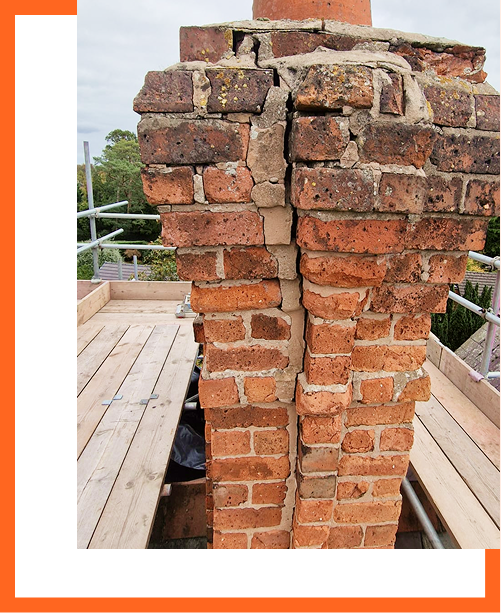
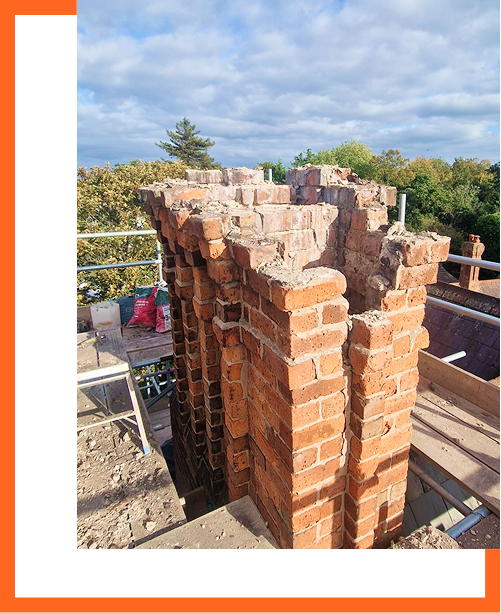
We began by carefully dismantling the top eight courses of the stack by hand. In heritage work, we don’t believe in “throwing away history.” Every brick that was still structurally sound was cleaned of old mortar and set aside for reuse. For the bricks that had perished due to frost damage, we sourced high-quality reclaimed Cheshire “Common” bricks.
These bricks are essential for a heritage match, as modern mass-produced bricks have a different size, texture, and “fired” finish that looks jarringly out of place on a Victorian stack.
While we advocate for lime mortar on all period properties, a chimney requires a specific “grade.” For this project, we utilised NHL 3.5 (Natural Hydraulic Lime).
This specific grade of lime provides the necessary “early set” required for high-exposure areas. It is strong enough to resist wind-driven rain and the sulfuric acids found in soot, yet it retains the essential flexibility to handle the thermal expansion that occurs every time a fire or boiler is used.
The stack was rebuilt course-by-course, following the original decorative “dog-tooth” or “corbelled” patterns that are common in Hoole. Inside the stack, we performed a process known as parging. This involves lining the internal flue with a smooth coat of lime mortar mixed with cow hair (a traditional additive for tensile strength).
This ensures the flue is airtight and helps smoke rise efficiently without getting trapped in the brickwork.
To top off the restoration, we applied a new lime-based flaunching at the head of the chimney to secure the pots. Unlike cement flaunching, lime-based mixes are slightly flexible, meaning they won’t crack when the clay pots expand in the heat.
Finally, we integrated new Code 4 lead flashings at the base of the stack, ensuring the transition between the masonry and the roof tiles was completely watertight.
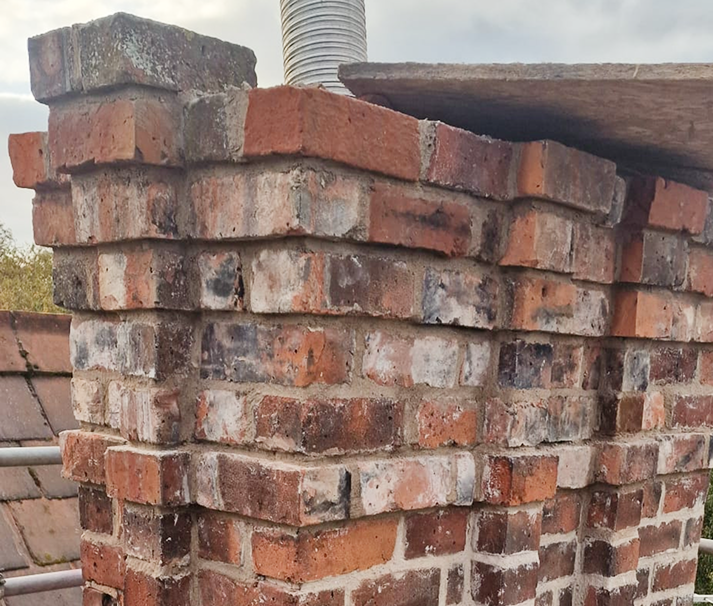
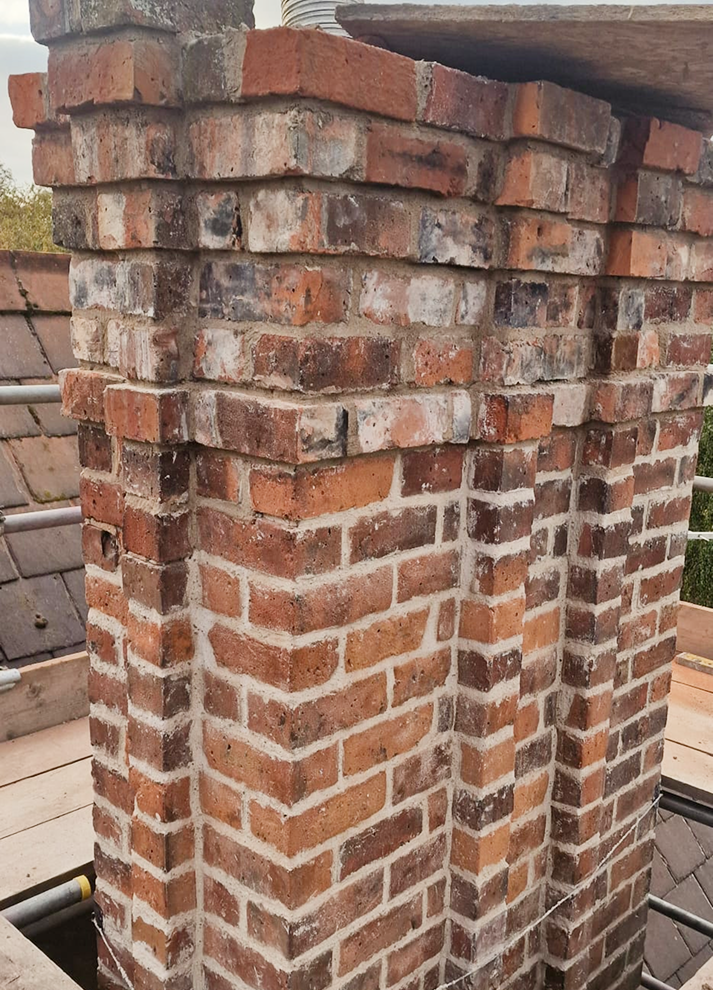
The transformation was both aesthetic and functional. Visually, the farmhouse regained its historic integrity. Here, the harsh, dark lines of the cement were replaced with soft, tonal joints that unified the masonry.
However, the real success was hidden within the walls. Within months of the project’s completion, the internal damp patches had vanished. By allowing the moisture to evaporate through the lime joints (this acted as a “wick”), the internal environment of the home became drier, warmer and healthier.
Rebuilding a chimney is a methodical, traditional task that requires a mason to work in challenging conditions. For Keith and the team, it is about preserving the “silhouette” of Chester’s residential streets.
“There’s a specific rhythm to rebuilding a stack,” our MD, Keith, reflects. “You have to think about wind, rain and heat all at once. By using reclaimed materials and the right lime mix, we aren’t just fixing a leak, we’re ensuring that the architectural character of Hoole is preserved. And at the end of the day, it’s rewarding to look up and see a chimney that looks exactly as the original builders intended.”
High-exposure masonry needs specialist attention before winter arrives.
Get in touch with our experts today for a professional stack assessment and heritage-compliant repair.
We treat every Chester home as if it were our own, ensuring minimal disruption to you and your neighbours.