
CASE STUDIES
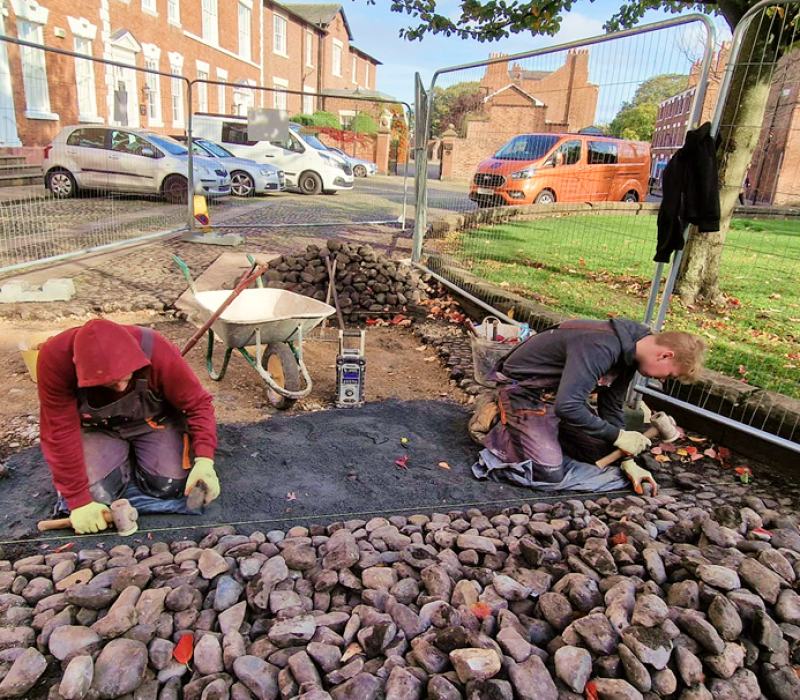
ABBEY SQUARE, CHESTER CATHEDRAL PRECINCT
Traditional Cobble Relaying, Abbey Square
Client Type: Heritage Public Realm / Ecclesiastical Estate
Location: Abbey Square, Chester Cathedral Precinct
Specialism: Heritage Groundworks, Stone Sett Laying, Traditional Bedding Methods
Materials: Reclaimed Natural Stone Setts, Hydraulic Lime (NHL), Crushed Grit Base.
Techniques: Hand-Setting, Permeable Bedding, Manual Tamping, Heritage Jointing.
THE HERITAGE CONTEXT:
THE HEART OF MEDIEVAL CHESTER
Abbey Square is one of the most architecturally significant spaces in the North West. As part of the Chester Cathedral precinct, the square is flanked by Grade I and Grade II listed buildings, some dating back to the 11th century. The traditional cobbled (or “sett”) ground surface is a vital part of this historic atmosphere. It isn’t just a road, but a functional piece of history that has survived centuries of horse-drawn carriages, and now, thousands of modern visitors every week.
THE CHALLENGE: BALANCING HISTORY
WITH MODERN SAFETY
Over time, the courtyard’s surface had become compromised. Years of heavy rainfall and shifting ground had caused the original stone setts to become loose and uneven. Large “potholes” in the cobbles were not only unsightly in such a prestigious location but had become significant trip hazards for the Cathedral’s visitors.
It was not an option to patch the area with modern bitumen or rapid-set concrete, as these materials are “unyielding.” They don’t allow water to drain through the ground, causing “frost heave” where the trapped water freezes and pops the stones out of their beds.
That being said, K. Blythin was commissioned to provide a permanent, heritage-compliant solution that would restore the level surface while maintaining the square’s medieval character. Here’s what our MD, Keith, had to say:
“Working in Abbey Square is a privilege, but it’s also a massive responsibility. You’re working in the shadow of the Cathedral on ground that hasn’t been significantly disturbed for centuries. You can’t just go in with a steamroller and a bag of cement. You have to understand how these stones were originally laid and why they lasted as long as they did. Our job was to bring back the safety of the square without losing a shred of its historic soul.”
THE K. BLYTHIN TECHNICAL APPROACH
1. METHODICAL EXTRACTION AND GRADING
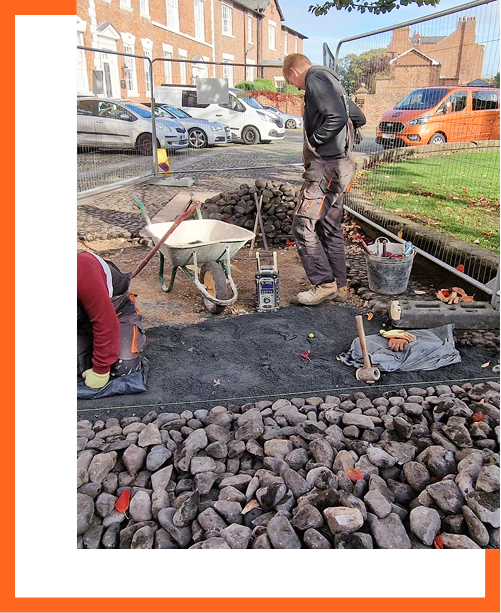
We began by carefully uplifting the failed sections of the courtyard by hand. Unlike modern paving, no two historic cobbles are exactly the same size or shape. Every stone we removed was cleaned of old debris and “graded” by size. This allowed us to plan the relaying process like a giant 3D jigsaw puzzle, ensuring that the natural variations in the stone would create a cohesive, stable surface.
2. THE TRADITIONAL BEDDING SYSTEM
The secret to a durable cobbled surface isn’t what’s on top, but what’s underneath. We avoided modern non-porous bedding compounds. Instead, we utilised a traditional Permeable Bedding System.
We laid a base of crushed grit and lime dust, compacted to provide a solid but “breathable” foundation. This is crucial because it allows rainwater to permeate through the joints and dissipate into the ground naturally. By preventing water from pooling under the stones, we eliminated the risk of the “heave” that had caused the original failure.
3. HAND-SETTING AND "TAMPING"
Each stone sett was hand-set by our expert masons. This is a labour-intensive process that requires a “mason’s eye” for levels. We used traditional rubber malls (heavy mallets) to tamp each stone into its bed, ensuring a tight “friction fit” against its neighbours.
In a heritage environment like Abbey Square, you don’t want a perfectly flat, clinical finish. The square should have subtle, natural undulations that reflect its age. Our team worked meticulously to ensure the surface was safe and level for walking, while retaining the “Old Chester” character of the precinct.
4. THE POINTING: LIME AND GRIT
Once the stones were set, the joints were filled with a specific mix of kiln-dried sand and hydraulic lime. This “flexible jointing” is far superior to modern grout. It allows for the subtle movement of the ground without cracking, and it prevents weeds from taking root while still allowing for the natural movement of moisture.
The Result: A Surface Fit for the Next Century
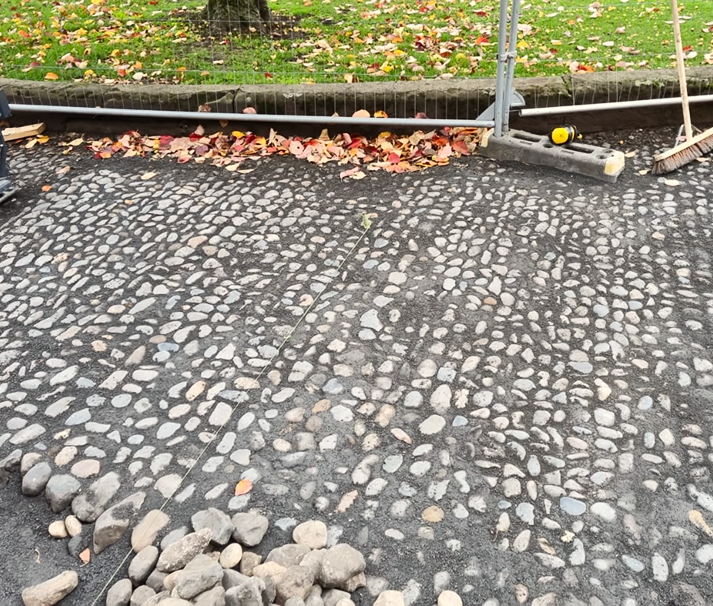
The restoration of the Abbey Square courtyard has been a resounding success. The trip hazards have been eliminated, and the drainage has been vastly improved, protecting the foundations of the surrounding listed buildings.
Visually, the project is a masterclass in “invisible repair.” To the casual visitor, the courtyard looks simply like a well-maintained piece of history. There are no jarring modern materials or “pockets” of mismatched stone. So just a seamless, robust ground surface that honours its Grade I surroundings.
REFLECTING ON THE PROJECT
“When you work on a site like Abbey Square, you aren’t just working for a client; you’re working for the city,” Keith reflects. “Knowing that our work will be walked on by generations of residents and tourists is a great feeling. We used the same methods the original masons used, and that’s why it’s going to last. It’s about doing things right, not doing them fast.”
HAVE A HERITAGE DRIVEWAY OR COURTYARD
IN NEED OF RESTORATION?
Don’t let modern paving ruin the character of your period home. Get in touch today for specialist advice on traditional stone laying and groundworks.
Chester
A LOCAL APPROACH TO EVERY
PROJECT, THE K. BLYTHIN STANDARD
We treat every Chester home as if it were our own, ensuring minimal disruption to you and your neighbours.
- Detailed Site Assessment: We evaluate your property’s specific materials, exposure, and condition before recommending anything.
- Custom Specification: No off-the-shelf mortars. We mix on-site to match your local stone or brick. Every batch of lime is tailored to your specific brick or stone — every time.
- Neighbourly Care: We run a clean, considerate site, particularly in Chester’s tighter residential streets and Conservation Areas.
- Aftercare Guidance: Every project includes maintenance advice so your masonry stays protected and clean long after we’ve packed up.